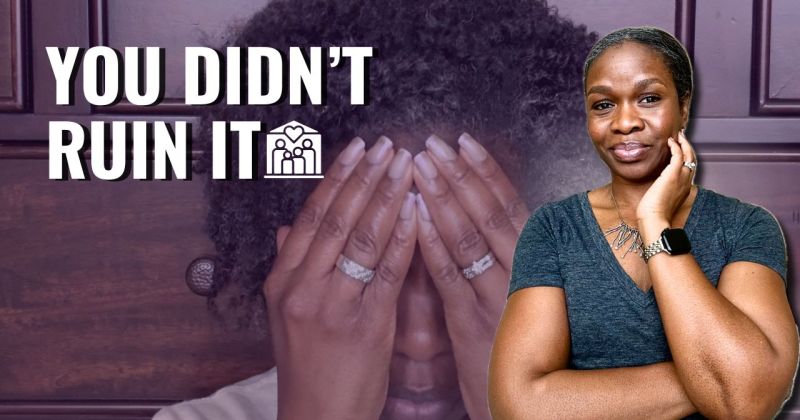

No, you didn’t ruin it.
No, you’re not a screw-up.
No, you’re not a loser.
You are as imperfect as I am, as everyone else in this world, and as imperfect as this world is. And I want to make that plain.
If you’ve seen my two previous videos on the importance of family—and the difference between building a family and just having children—you know they are not the same. Ideally, you build a family. But ideals happen in perfect situations, and this life is not perfect.
So if you saw those videos and found yourself feeling like you blew it—like there’s no hope for your situation, like you and your children can’t possibly grow into a family that impacts not just your lineage but society as well—I’m here to tell you: it’s not too late.
So, how do we pivot?
How do we make the most—or make the best—out of a situation that didn’t start out ideal?
There are lots of reasons why you may have started having children before thinking seriously about building a family. Let’s be real—making children is pretty fun! You do that—often without fully considering what comes from that kind of pleasure—and you look up, and now there’s a child.
Maybe you’re not even with the guy you were having fun with. Maybe you were dating. Maybe he was “the guy,” but you two hadn’t talked about anything deeper than that. There are so many reasons we end up having children outside of a family structure—one where those children can thrive and where we can stay sane.
So now you’ve got this child. Maybe you’re not with anyone. Maybe you are with their father, but you’re not married. Maybe you’re living in separate homes. Maybe you’re figuring it all out.
The question becomes: How do I create a family out of this situation?
1. You need a vision.
From where you are right now, what do you envision for yourself and your children? What kind of legacy do you want to pass down, starting now?
You can’t do anything about the past. These children are here, and they are a blessing. So how do you give them the best foundation—within a family—from which they can thrive?
2. You need values.
Call it a family philosophy. Call it your “why.” You need to identify your non-negotiables—the things you stand ten toes down on.
Because once your kids start talking, they start asking questions. And if you haven’t thought through your values—or your boundaries, which is my next point—you’ll end up a moving target. One day it’s yes. The next day it’s no. Now the kids are confused, and you feel like a mess because you’re being inconsistent.
But when you’ve already thought through your values and standards, parenting gets clearer. You don’t have to agonize over every decision—you’ve already decided what your family is built on.
3. You need boundaries.
This time, I’m talking about boundaries for you.
Let’s say you decide, “I’m not having any more children outside of marriage.” Then, you have to create boundaries that support that decision. If you’re serious about restructuring your current situation in a way that aligns with your future vision of family, those boundaries will need to be tight.
Let me be real clear about what I mean when I say “family structure.” I’m talking about a home that includes a mother and father, siblings, and potentially grandparents or extended family—all working together to provide context, connection, and stability.
That’s different from just being biologically related or having kids with different people in different homes. That’s not the structure of a family—it’s a group of people who are related. Structure gives context.
4. You make hard choices.
Ask yourself: What am I not going to do anymore because I’m invested in building something different for myself and my children?
Maybe your setup today isn’t ideal—but what choices can you make today to move toward the family you want?
That kind of family—one where both parents are working together, where extended family plays a part, where there’s legacy, belonging, history, and love—that doesn’t just happen. Families like that are built.
Even if you’re not in a nuclear family structure right now, you can start making choices that lead you in that direction. From this point forward, it’s not about condemnation. It’s not about “woulda, shoulda, coulda.” It’s about what you’re choosing now that you know more and want more.
That is powerful parenting.
It’s easy to pass down ideals when your situation is ideal. But life is messy. And when your child starts asking, “Why doesn’t my dad live here?” or “Why aren’t we like my friend’s family?” You get the chance to model honesty and growth.
You get to say:
“You’re right. Things are different. But Mommy is making decisions now that I believe are best for you. I love you, and I’m working toward something better for both of us.”
And when they see that?
When they notice you’re no longer entertaining every guy who shows interest…
When they see you making different choices than you used to…
When they see you doing the hard things…
They learn from that.
They learn that it’s okay to pivot.
They learn that growth is possible.
They learn that doing better is worth it.
That is parenting, too.
It’s not about being perfect. None of us are. We all have moments where we’ve missed the mark. But your children need to see that when you mess up, you make a U-turn. That you’re willing to go the long, hard way back—because it’s the right direction. And they’ll learn that too.
Not doing everything perfectly from the beginning does not mean you’ve failed. It means you’re human.
Show them the pivot.
Show them a new perspective.
Show them the patience and the grace you’re showing yourself.
Because that’s what they’ll learn to give themselves when they make mistakes. And they will.
The real question becomes: What do I do when I’ve made a mistake?
Do I keep going the same way?
Or do I stop, think, pray, and choose a different path?
You hear pediatrician.
You hear “stay-at-home mom for 20 years.”
You hear all these things and maybe think I’ve got it all figured out.
Nope, I’m doing this thing just like you.
My childhood experience put me in a corner that I didn’t like. And I thought, I’ve got to do this differently. So I started figuring it out. It’s taken a lot of thought, a lot of prayer, and a lot of tears.
It’s my honor to share what I’ve learned—so you don’t have to start from scratch.
None of us, including me, are getting this parenting thing right all the time. But I am a princess of the pivot. And if you’ve been watching or reading and thinking, I really wish I had done things differently, then here’s your chance:
Do things differently starting today.
As my mentor, Crystal Evans Hurst, says, “Today is Day One.”
What’s happened has happened.
But today is Day One.
What will you do today to set yourself—and your children—on a better path?
I’m rooting for you…
Join me for more insight on family dynamics.

**The views and opinions expressed should not be taken as medical advice. The content here is for informational purposes only, and because each person is so unique, please consult your health care professional for any health questions.
 Vanessa A. Harris